
Do Australian Tradies and Clinics Really Need a Website in 2026, or Is a Google Business Profile Enough?
An honest look at when a Google Business Profile is enough for a trade or clinic business in Australia, and the point where going without a website starts costing you real work.
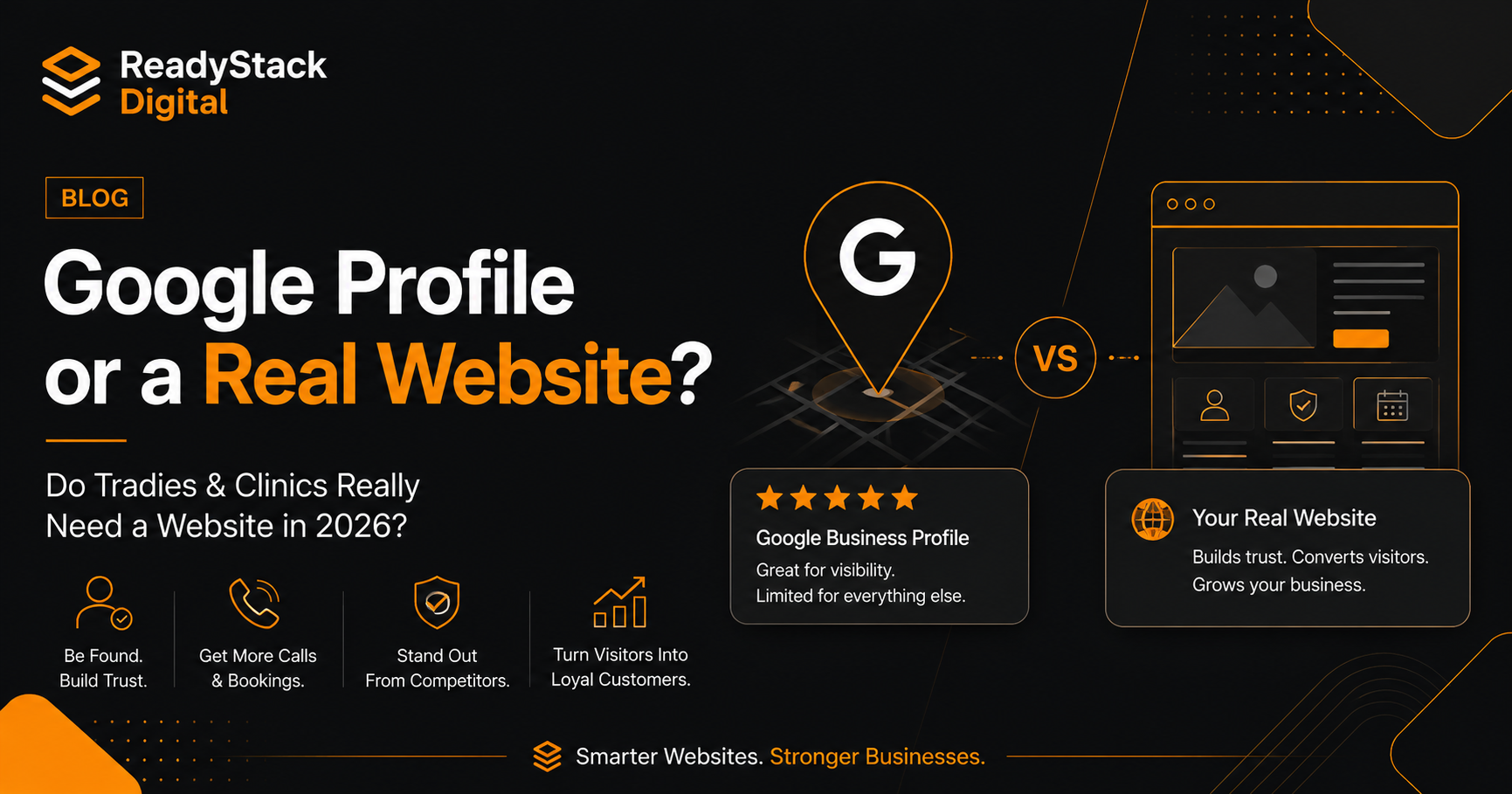
Most web designers won’t admit this, but for a lot of trades and clinics a Google Business Profile really is doing most of the heavy lifting. If you’re a solo plumber booked out three weeks in advance on word of mouth and a steady run of “near me” searches, a website is not the thing standing between you and more money.
So no, you don’t automatically need a website in 2026. That’s the honest answer, and anyone who tells you otherwise is usually the person selling the website.
But “enough” is doing a lot of work in that question. Enough for what? Enough to keep the phone ringing this month is a very different thing from enough to win the jobs you actually want, protect the business you’ve built, and not be at the mercy of a company that can switch you off without warning. That’s where a Google Business Profile on its own starts to show its cracks.
When a Google Business Profile genuinely is enough
Be honest with yourself here, because there are real situations where you shouldn’t spend a cent on a site yet.
You’re probably fine on a Profile alone if you’re a one-person operation, you get plenty of work from referrals and repeat customers, the jobs are small and fast to quote, and you’re not trying to grow. A mobile mechanic, a solo cleaner, a mowing round. Google gives you a map pin, a phone number, reviews, hours and photos, and for a certain kind of business that covers the whole customer journey. Someone searches, sees five stars, taps call, done.
If that’s you, keep stacking reviews and keep your Profile updated. A half-finished website would just be a box you tick once and then ignore.
The trouble is that most trades and clinics aren’t that business. And the ones who want to be more than that hit a wall.
Where a Profile-only setup quietly costs you
None of this shows up as a dramatic failure. There’s no day the phone stops. It’s quieter than that. It’s the good jobs you never hear about, and the ones that go to the competitor who looked more legitimate.
You’re renting your storefront on someone else’s land. Your Profile isn’t yours. Google can suspend it over a policy trip-up, a dodgy competitor report, or a change of address, and appeals can drag on for weeks with your listing dark the whole time. Every plumber and physio who has been through a suspension will tell you the same thing: it’s terrifying precisely because there’s no fallback. A website is the one online asset you actually own.
The high-value jobs need more convincing. A $300 tap replacement gets booked off a review score. A $40,000 switchboard upgrade, a full bathroom, a commercial fit-out, a builder deciding who does the electrical on a whole townhouse? That client wants to see your licence number, your insurance, past work, the standards you hold, maybe a few words on how you run a job. There’s nowhere to put any of that on a Profile. So you either lose the enquiry or spend the first ten minutes of every call re-establishing that you’re a real, credentialled business.
Clinics live and die on booking and trust, and a Profile does neither well. Patients increasingly want to book at 9pm from the couch, not ring during business hours. A Profile can link to a booking tool, but it can’t reassure a nervous new patient with practitioner bios, a plain explanation of a first appointment, your approach to their condition, or clear info on private health rebates. For allied health especially (physio, psych, dental, podiatry), the write-up is the difference between “I’ll think about it” and a booked slot. And relying entirely on HealthEngine or a similar marketplace means you’re paying to rent patients who never learn your name.
You can’t capture the people who aren’t ready yet. Most searchers aren’t ready to book on the spot. On a Profile, if they don’t call, they’re gone, and you have no idea they ever existed. A simple site with a quote form or a callback request catches those people, and gives you an email or a number you can follow up. Over a year that’s a lot of work you currently never see.
Your ads have nowhere good to land.**** The moment you want to run Google Ads to win more of a specific job, whether that’s burst pipes, Invisalign, or whatever pays well, you need a page built to convert that click. Send paid traffic to a Profile and you’re paying for clicks that leak straight back into the sea of competitors.
Your competitor has both, and it shows. When two electricians have similar reviews, the one whose name links through to a fast, tidy website that answers the customer’s questions wins the toss-up more often than not. It reads as “established business” versus “bloke with a phone.” Often you’re not losing to better work. You’re losing to a better first impression.
Profile and website were never really either/or
This is the part that actually matters, and the reason the original question is a bit of a trap. A Profile and a website aren’t competing options. They’re two halves of the same system, and they make each other stronger.
Google leans on signals from your website, things like a consistent name, address and phone number and genuine location and service content, to decide how much to trust and rank your Profile in the local map results. A good site can lift the Profile you already have. Meanwhile the Profile funnels ready-to-buy searchers to you now, and the site converts the ones who need a bit more before they commit. Take either one away and the other works harder for less.
So the real question isn’t “Profile or website.” It’s “am I leaving work on the table by having only half the setup?”
What these businesses actually need (and what they don’t)
If you do build something, the mistake to avoid is the twelve-page brochure site nobody reads. Trades and clinics don’t need that, and it’s usually what makes people write websites off as a waste of money in the first place.
What earns its keep is lean. It loads fast on a phone on patchy reception. It says in one clear line what you do and where. It lists your services, shows the trust signals (licence, insurance, memberships, real photos of real jobs or your actual rooms), pulls your reviews through, and gives an obvious way to book or get a quote. For a clinic, add proper practitioner profiles and online booking. That’s it. A site like that can be four or five pages and still outperform a competitor’s sprawling one, because every part of it is pointed at the customer’s next step.
Speed matters here too, not as a technical vanity thing but because your customer is on mobile, often outdoors or in a waiting room, and a slow page loses them before it loads. It’s one of the reasons we build client sites on Astro and Cloudflare rather than a heavy page-builder. The customer never waits, and you’re not paying for bloat you can’t see.
So, do you need one?
If you’re small, happy, and full up on referrals: not yet, and don’t let anyone guilt you into it. Keep your Profile sharp.
If you want to win bigger jobs, book patients while you sleep, run ads that pay off, stop renting your entire online presence from Google, or simply not look smaller than the competitor down the road, then a Profile alone is quietly holding you back, and a lean site working alongside it is one of the better-value moves you can make.
The Profile brings people to the door. The website is what convinces the good ones to come in.
Not sure which camp you’re in? Fair question. Book a free website strategy call and we’ll give you a straight answer, including “you don’t need us yet” if that’s genuinely the case. ReadyStack Digital builds fast, no-nonsense websites for Australian trades, clinics and professional services.